



Super fast and easy Quality chooser to design your own dragon.
Simply choose an attribute from each section and put it together.
The word 'dragon' is an umbrella term, encapsulating all manner of creatures, from mythic serpents to monstrous hybrids. As a class of supernatural being, creatures classified as dragons possess some combination of related traits, major and secondary.
Some claim the creature is an evil being sent by the Great Evil to harm mankind. Others tell tales about benevolent dragons who sacrificed themselves to save humans or promote fertility. Both disaster and bounty have followed in their wakes.
Dragonology, draconology or dracology is the study of dragons. It is a broad term that could cover any form of study including historic work, spiritual paths, cryptozoology studies or analysis of fantasy fiction. This term is an example of a neologism - a new term created to describe a dragon researcher of any type.
Someone involved in this study is called a dragonologist or draconologist. There is no formal way to become one, nor any formal qualifications or testing. A dragonologist is someone that says they are one.
Beyond the ability to control natural elements or fly without wings, dragons also present with supernatural powers. Supernatural powers are what set dragons apart from other animals. A typical large serpent or a crocodile would not a dragon make unless imbued with additional powers. There are subtle differences between the terms for an animal that thinks like a human and an animal that looks like a human.
 A term used to describe a creature that shares few to none of the characteristic traits of humans. It is also used to describe a regular, non-sapient animal.
 A quadruped, traditionally, means an animal which walks on four legs. This is mainly to distinguish them from bipeds, which walk on two.
 A taur is a word which refers to any creature with an anthro/furry humanoid upper body with a non-anthropomorphic animal body, in the same style as the centaur's human and horse body structure.
 Anthropomorphic animals are sometimes called anthro or morphic for short. Anthropomorphic is a word which literally means "human shaped" (from the Greek anthropos (human being) + morphe (shape)). It is used to describe a concept called anthropomorphism, or ascribing human characteristics to non-human beings or objects.
 *TNT has stated that Humans do not exist in Neopia, so keep that in mind.*
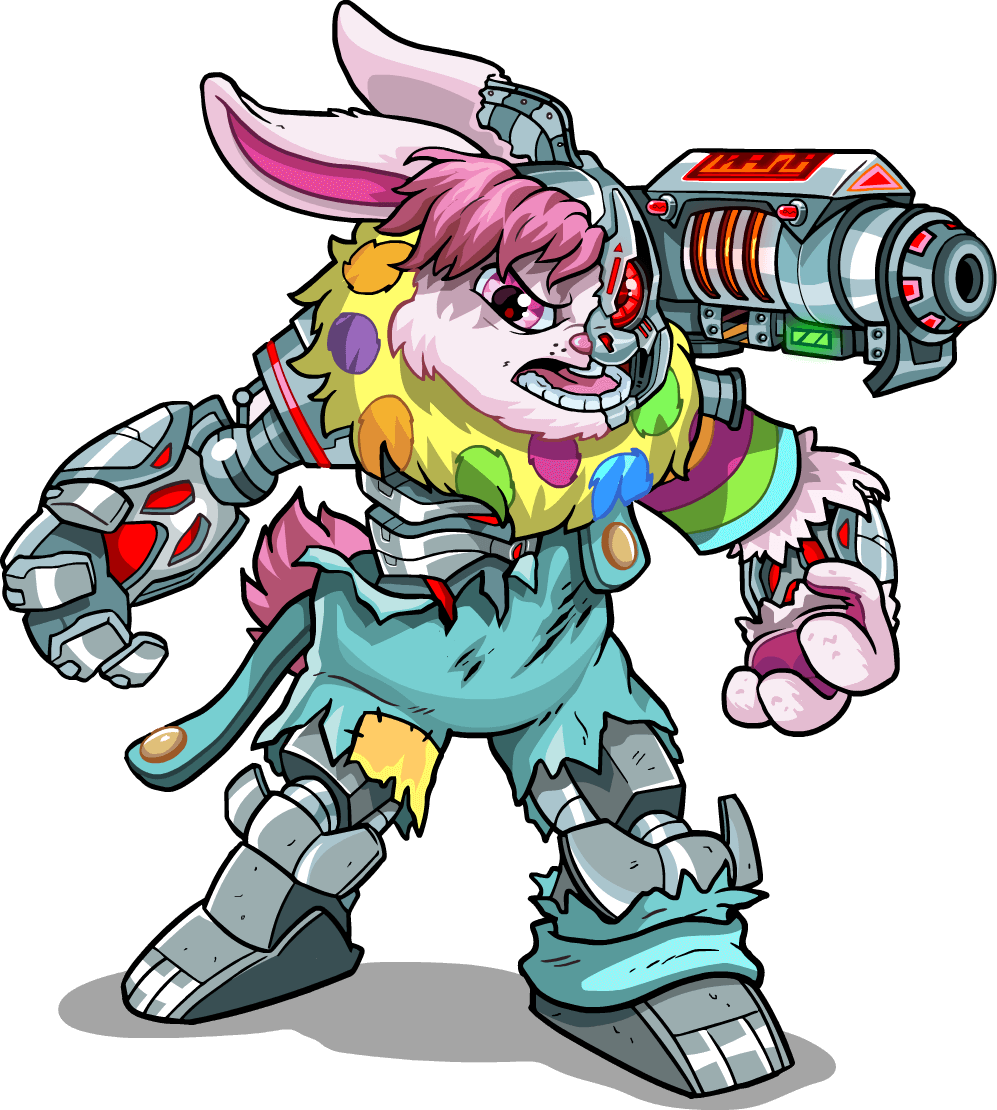 The term "mecha" (which is both singular and plural, like "fish") is originally of Japanese origin, derived from the English word "mechanism" Sometimes referred to as animatronic or automaton.
Information for this section is from Dungeons & Dragons Draconomicon - Wizards of the Coast, all rights reserved
 Dragon eggs come in various colors and sizes depending on the originating parents.
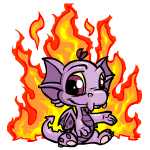 A newly hatched dragon has a full array of abilities, although each ability is but a shadow of it's full power.
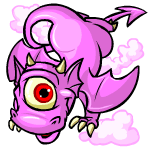 Wyrmlings spend a few years dwelling with one or both of their parents. Some parents welcome this time as an opportunity to teach their offspring lessons beyond its inherited knowledge: the best areas to hunt, what to look for in a lair, how to begin building a hoard, and other knowledge a growing dragon needs to gain.
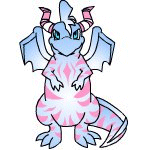 A young dragon must leave the nest (if it has not already done so) before territoriality and greed transform the parent–child relationship into a bitter rivalry.
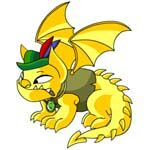 The dragon is well on its way to adulthood. It has nowhere near the physical power of an adult, but it has an adults body proportions. Some species exhibit the first of their magical powers at this stage.
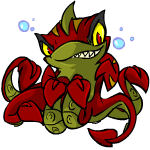 By this age, a dragon's scales have developed into armor formidable enough to turn aside all but magic weaponry or the teeth and claws of other dragons. A young adult dragon also masters its first spells and shows evidence of a formidable intellect. A young adult dragon severs its ties with nestmates, mentors, and parents (if it has not done so already) and establishes its own lair and territory.
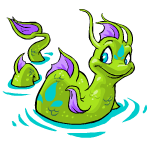 By this point of a dragon's life, its physical growth begins to slow-- but its body is just entering its prime. With the dragon's initial growth spurt over, the dragon's body becomes even more powerful and healthy. An adult dragon continues to hone its mental faculties and masters more skills and magic.
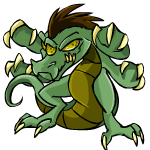 By this stage of life, a dragon is truely a force to be reckoned with-- and it knows it. Mature adults display a degree of self-confidence that younger dragons lack.
 By the time most dragons reach this age, their physical growth stops, though they become even more hardy, and their minds and magical powers continue to expand with the passing centuries.
 Dragons have reached the end of their reproductive years. Many compensate by mentoring younger dragons of the species. These dragons have little to fear from much younger dragons that have not yet reached adulthood, and they have much wisdom and experience to pass on.
 Most dragons at this age have minds better than the best and brightest humans, and they can tap into vast stores of memories and knowledge, both practical and esoteric.
 Dragons that reach this stage usually begin to show some outward signs of aging; Their scales begin to chip and crack at the edges and also to darken and lose their luster, and the irises in their eyes begin to fade, so that their eyes begin to resemble featureless orbs.
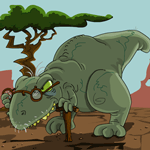 Some Great Wyrms spend years hibernating or counting and recounting their hoards, for lack of anything better to do. Others ignite conflict, revert to behaviors of younger dragons, hunting and raiding at whim.
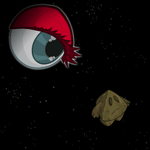 Dragon enter twilight slightly before fading from existence.
Food energy is chemical energy that animals derive from food to sustain their metabolism and muscular activity. This is usually measured in calories or joules. Other smaller components of the diet may contribute to the energy input. Some diet components that provide little or no food energy, such as water, minerals, vitamins, cholesterol, and fiber, may still be necessary for health and survival for other reasons. Some organisms have instead anaerobic respiration, which extracts energy from food by reactions that do not require oxygen.


Sleep is a naturally occurring altered state of consciousness. It is characterized by reduced awareness and responsiveness to the environment. Sleep is not a uniform state; it consists of distinct stages that cycle repeatedly throughout the night, each identified by characteristic brain wave patterns
Circadian rhythms are fundamental to life. In nature, rest/activity patterns are extremely diverse; not always affected by daylight. Environmental pressures such as light cycles, temperature cycles, food availability, and timing of predator activity selectively shape the activity patterns of different species.


Rest/Activity Patterns Explained written by:
A J K Phillips, B D Fulcher, P A Robinson, E B Klerman | Editor: Mark S Alber [PMCID: PMC3764015 | PMID: 24039566]
ANIMAL BEHAVIORAL PATTERNS [critter.science/animal-behavioral-patterns]
Are Alternative Sleep Cycles More Efficient? [sleepdynamics.com/biphasic-and-polyphasic-sleep-alternative-sleep-cycles/]

 Fairy dragons are the smallest of all dragons, associated with insects and fae folk. They share many traits with fairies, such as a trickster nature and a fondness for sweet foods.
Dragonflies are slender, long-limbed, and long-tailed lizards bearing two pairs of wings located medially on the dorsal surface of the body. Their appendages can grow up to one meter in length and are membranous with reduced venation. At rest, the wings are held over the back of the body and extended horizontally upon active flight. Each of the dragonfly's limbs bears a series of four clawed digits.
Salamanders are creatures that can live in fire and are immune to its effects. They are a small, lizard-like creature with a red body and black spots. Long, low slung body with short, stubby legs ending in retractable claws. Smooth skinned, their saliva and skin mucas membranes are both laced with a strong poison. It has very small eyes with no eyelids and poor eye sight. Its mouth extends across the width of its head, and can open to the width of its body, its tongue is long, wide and ends in a fork. The tail is about the same length of the body, and very thick. When the salamander feels threatened, its entire body will glow like fire embers.
The Gargouille is one of the few city-dwellers among Dragons. They cannot sustain flight due to their small wings but they are dextrous and are expert jumpers. Covered in a thick leathery hide instead of scales, a goat horned dog-like face with large fangs, on top of a long neck, the body of a lion, and legs of an eagle. They are capable of creating large amounts of water from their mouths, to the point of flooding the countryside.
Wyverns (sometimes spelled Vouivre) are highly aggressive and predatory, and is dramatically less intelligent than its draconic cousins. They have two legs, two leathery wings (Which are sometimes used as legs, and usually have claws at the bend.), covered in scales, and often a pointed tail which is said to be a venomous stinger. Its head is described to be wedge-shaped like that of a crocodile. Said to spit fire or corrosive acid.
These creatures possess a long, serpentine body, a dragon's head (sometimes with horns), fangs that inject venom, no legs at all, an arrow-tipped tail, and two or more wings. Distantly related to wyverns, amphipteres are equally cruel and prone to violence. Like wyverns, they have serpentine bodies and bat-like wings. Unlike wyverns, however, amphipteres must use the long claws on the tips of their wings to propel their bodies along as they awkwardly leap and soar a few feet off the ground.
The knucker has a slithering sea serpent's body, covered in scales, vestigal wings, cold, bold sea serpent's eyes and teeth as sharp as swords in a hissing sea serpent's mouth.
The drake is a dragon with four limbs, no wings, low-slung bodies (much like crocodiles and alligators) with their bellies lying across the ground, usually very large in size. A drake is not as intelligent as a full blown dragon; but still capable of a breath weapon and simple abilities.
Have several forms they can take, including human from the waist up with a serpent's tail in place of legs, human from the neck up, fully serpent, and fully human. Sometimes they live in oceans, rivers, lakes, and springs, and do not want their environments to be disturbed or polluted. Other times they inhabit a subterranean cave system.
A large and long, wingless, 2 legged creature. It moves by slithering on the ground like a snake. Its forelimbs are small relative to its body size, and are used primarily to manipulate prey and other smaller objects. Lindworms are known for their predatory intelligence and large appetite. Lindworms are known for their long lifespan, predatory intelligence, and large appetite. They do not have the ability to breathe fire; they are also cold-blooded, carnivorous, aggressive, and territorial.
The Tarasque is a huge dragon, half animal, half fish, fatter than a bull, longer than a horse, it had the face and head of a lion, teeth sharp as swords, the mane of a horse, a back that is hatchet-sharp with bristly scales keen as augers, six feet with bear-like claws, the tail of a serpent, and a double shield/carapace, like a tortoise's, on each side. This creature can expel a poisonous breath.
The Leviathan is a monstrous, giant sea creature from the Bible and Jewish mythology that is often described as a sea serpent or dragon, and is described as having smoke come out if his nostrils and fire coming out of his mouth. In Dungeons & Dragons, the Leviathan is a colossal sea monster that encircles the world. It is said to have impenetrable armor scaled-skin, along with sleek limbs, blade-like teeth, glowing white eyes, and of immense size.
Merwyrms are found along the coastlines of the world, distant kin to the mighty winged dragons. All merwyrms possess long, almost serpentine and sinuous bodies covered in scales, can breathe air and water, their bodies able to heal at a tremendous rate, and can be highly venomous.
This particular creature is called many names by assorted Aboriginal tribes of Australia. (Bolung, Muitj, Dhakkan, Goorialla, Numereji, Galeru, Yero, Wanampi, & Julunggul)In the first instance, the rainbow itself. The serpent is sometimes ascribed with a having crest or a mane or on its head, or being bearded as well. It is single-headed, it may possess a double-body. Witij/Wititj is understood to be of immense proportions and inhabits deep permanent waterholes and is in control of life's most precious resource, water.
Hydra was a dragon-like water serpent with fatally venomous breath, blood and fangs, it has anywhere between five and 100 heads, although most sources put the number somewhere between seven and nine. For each head cut off, one or two more grew back in its place.
A Zilant is a legendary creature with the head of a dragon, the body of a bird, the legs of a chicken, the tail of a snake, the ears of a canine, the red wings of a bat or bird, sharp teeth, dark-gray feathers and scaly dark-gray skin.
Description goes here; specifically physical characteristics and size comparison.
Description goes here; specifically physical characteristics and size comparison.
Description goes here; specifically physical characteristics and size comparison.
Description goes here; specifically physical characteristics and size comparison.
Description goes here; specifically physical characteristics and size comparison.
Description goes here; specifically physical characteristics and size comparison.
Description goes here; specifically physical characteristics and size comparison.
Description goes here; specifically physical characteristics and size comparison.
Description goes here; specifically physical characteristics and size comparison.
Description goes here; specifically physical characteristics and size comparison.
Description goes here; specifically physical characteristics and size comparison.
Description goes here; specifically physical characteristics and size comparison.
Description goes here; specifically physical characteristics and size comparison.
Description goes here; specifically physical characteristics and size comparison.
Fairy dragons are the smallest of all dragons, associated with insects and fae folk. They share many traits with fairies, such as a trickster nature and a fondness for sweet foods.
Dragonflies are slender, long-limbed, and long-tailed lizards bearing two pairs of wings located medially on the dorsal surface of the body. Their appendages can grow up to one meter in length and are membranous with reduced venation. At rest, the wings are held over the back of the body and extended horizontally upon active flight. Each of the dragonfly's limbs bears a series of four clawed digits.
Salamanders are creatures that can live in fire and are immune to its effects. They are a small, lizard-like creature with a red body and black spots. Long, low slung body with short, stubby legs ending in retractable claws. Smooth skinned, their saliva and skin mucas membranes are both laced with a strong poison. It has very small eyes with no eyelids and poor eye sight. Its mouth extends across the width of its head, and can open to the width of its body, its tongue is long, wide and ends in a fork. The tail is about the same length of the body, and very thick. When the salamander feels threatened, its entire body will glow like fire embers.
The Gargouille is one of the few city-dwellers among Dragons. They cannot sustain flight due to their small wings but they are dextrous and are expert jumpers. Covered in a thick leathery hide instead of scales, a goat horned dog-like face with large fangs, on top of a long neck, the body of a lion, and legs of an eagle. They are capable of creating large amounts of water from their mouths, to the point of flooding the countryside.
Wyverns (sometimes spelled Vouivre) are highly aggressive and predatory, and is dramatically less intelligent than its draconic cousins. They have two legs, two leathery wings (Which are sometimes used as legs, and usually have claws at the bend.), covered in scales, and often a pointed tail which is said to be a venomous stinger. Its head is described to be wedge-shaped like that of a crocodile. Said to spit fire or corrosive acid.
These creatures possess a long, serpentine body, a dragon's head (sometimes with horns), fangs that inject venom, no legs at all, an arrow-tipped tail, and two or more wings. Distantly related to wyverns, amphipteres are equally cruel and prone to violence. Like wyverns, they have serpentine bodies and bat-like wings. Unlike wyverns, however, amphipteres must use the long claws on the tips of their wings to propel their bodies along as they awkwardly leap and soar a few feet off the ground.
The knucker has a slithering sea serpent's body, covered in scales, vestigal wings, cold, bold sea serpent's eyes and teeth as sharp as swords in a hissing sea serpent's mouth.
The drake is a dragon with four limbs, no wings, low-slung bodies (much like crocodiles and alligators) with their bellies lying across the ground, usually very large in size. A drake is not as intelligent as a full blown dragon; but still capable of a breath weapon and simple abilities.
Have several forms they can take, including human from the waist up with a serpent's tail in place of legs, human from the neck up, fully serpent, and fully human. Sometimes they live in oceans, rivers, lakes, and springs, and do not want their environments to be disturbed or polluted. Other times they inhabit a subterranean cave system.
A large and long, wingless, 2 legged creature. It moves by slithering on the ground like a snake. Its forelimbs are small relative to its body size, and are used primarily to manipulate prey and other smaller objects. Lindworms are known for their predatory intelligence and large appetite. Lindworms are known for their long lifespan, predatory intelligence, and large appetite. They do not have the ability to breathe fire; they are also cold-blooded, carnivorous, aggressive, and territorial.
The Tarasque is a huge dragon, half animal, half fish, fatter than a bull, longer than a horse, it had the face and head of a lion, teeth sharp as swords, the mane of a horse, a back that is hatchet-sharp with bristly scales keen as augers, six feet with bear-like claws, the tail of a serpent, and a double shield/carapace, like a tortoise's, on each side. This creature can expel a poisonous breath.
The Leviathan is a monstrous, giant sea creature from the Bible and Jewish mythology that is often described as a sea serpent or dragon, and is described as having smoke come out if his nostrils and fire coming out of his mouth. In Dungeons & Dragons, the Leviathan is a colossal sea monster that encircles the world. It is said to have impenetrable armor scaled-skin, along with sleek limbs, blade-like teeth, glowing white eyes, and of immense size.
Merwyrms are found along the coastlines of the world, distant kin to the mighty winged dragons. All merwyrms possess long, almost serpentine and sinuous bodies covered in scales, can breathe air and water, their bodies able to heal at a tremendous rate, and can be highly venomous.
This particular creature is called many names by assorted Aboriginal tribes of Australia. (Bolung, Muitj, Dhakkan, Goorialla, Numereji, Galeru, Yero, Wanampi, & Julunggul)In the first instance, the rainbow itself. The serpent is sometimes ascribed with a having crest or a mane or on its head, or being bearded as well. It is single-headed, it may possess a double-body. Witij/Wititj is understood to be of immense proportions and inhabits deep permanent waterholes and is in control of life's most precious resource, water.
Hydra was a dragon-like water serpent with fatally venomous breath, blood and fangs, it has anywhere between five and 100 heads, although most sources put the number somewhere between seven and nine. For each head cut off, one or two more grew back in its place.
A Zilant is a legendary creature with the head of a dragon, the body of a bird, the legs of a chicken, the tail of a snake, the ears of a canine, the red wings of a bat or bird, sharp teeth, dark-gray feathers and scaly dark-gray skin.
Description goes here; specifically physical characteristics and size comparison.
Description goes here; specifically physical characteristics and size comparison.
Description goes here; specifically physical characteristics and size comparison.
Description goes here; specifically physical characteristics and size comparison.
Description goes here; specifically physical characteristics and size comparison.
Description goes here; specifically physical characteristics and size comparison.
Description goes here; specifically physical characteristics and size comparison.
Description goes here; specifically physical characteristics and size comparison.
Description goes here; specifically physical characteristics and size comparison.
Description goes here; specifically physical characteristics and size comparison.
Description goes here; specifically physical characteristics and size comparison.
Description goes here; specifically physical characteristics and size comparison.
Description goes here; specifically physical characteristics and size comparison.
Description goes here; specifically physical characteristics and size comparison.
A breath weapon is the cone or line shaped weapon exhaled by dragons in battle or as needed. Each type of dragon has a different breath weapon. Breath weapons stem either through magic or from a "Draconis Fundamentum," located either in the dragon's throat or chest. The Fundamentum contains and produces key ingredients for special breath.
Dragon breath weapons are not spells, so they cannot be directly countered by other spells. However, mitigating the damage through resistance, immunity, or protective items is possible. Younger dragons generally have weaker breath weapons, dealing less damage and affecting a smaller area.
 This filmy, oily breath is a billowing orange flame with more ash than most other dragon flames, similar to pyroclastic blast of a volcano. It creates large amounts of black smoke and leaves behind an oily soot when the flames die.
 Consisting of fire and scalding molten rock, these lava blasts are shot out with great force and can cause serious damage once they hit their target. May be formed into a stream, chunky blast, or lobbed in small or large balls.
 An unusual element at the depths of the netherworld with unmatched destructive capabilities, comprised of dark energy then proceeds to instantly incinerate just about anything in its path.
 Plasma works almost like a cross between a liquid and a gas; it consists of an explosive semi-solid mass of acetylene-oxygen flames. When at charging energy and shooting, high-pitched sound emits.
When it hits a target, it explodes on impact. The blast of plasma will explode even if it does not hit a target at high altitude.
Plasma works almost like a cross between a liquid and a gas; it consists of an explosive semi-solid mass of acetylene-oxygen flames. When at charging energy and shooting, high-pitched sound emits.
When it hits a target, it explodes on impact. The blast of plasma will explode even if it does not hit a target at high altitude.
 Corrosive acid like bellowing fire that burns by heat and it's acidic content. Has an oil like consistency and sheen that is left behind.
 A bioluminescent flame which burns beneath the surface of the water at high temperatures in an azure hue.
 This fire burns hotter than typical dragon fire; measured at temperatures well over 1000 degrees Fahrenheit. Dragons with this type of breath tend to have a low body temperature, and can actually vaporize the area around the blast.
 Typically this breath comes in a steady stream. Containing liquid nitrogen, the breath weapon can reach temperatures up to -321 degrees Fahrenheit. Dragons with this type of breath tend to have a low body temperature, and can actually freeze the area around it.
 The ability to produce bio-electricity, can attack and stun targets at mid-ranges with highly-charged electron waves or currents. They bite their prey with their electrical bite, stunning and paralyzing them. It also uses its electrical ability as a defense mechanism from predators.
 A cloud of evil energy that can twist the skin & bones of the target while causing asphyxiation. As it is derived from chaotic forces, it is unpredictable in total effects.
 Pure light (Which appears to be iridescent rainbows) pours from the dragon's mouth and seeks out the evil ones and destroys them with a bolt of holiness. This does not harm those pure of heart.
 A mighty gust that surrounds it's target with more colours than the mind can perceive. It can cause confusion and blindness.
 This 'breath' manifests as a puff of gas that is intoxicating. Living creatures in the cloud become fascinated. This condition lasts as long as a creature is in the cloud.
 A violet poisonous mist that causes suffocation, flows thickly and low to the ground and dissipates quickly. Does not kill plant life.
 This 'breath' manifests as sonic sounds that travels as waves of blue rings. The blast ripples through the air and can push obstacles and enemies back at great speed. This is deadly at close range; and disorienting at long range.
 A poisonous gas that can include bursts, streams, spheres, even a mist of it from the mouth, it becomes less potent and less concentrated once it has expanded. Acts as a paralyctic upon inhalation or contact.
 A jet of brown and green toxic liquid sprays with some misting cloud behavior; which can cause paralysis or worse with inhalation or physical contact with the substance.
 A type of elemental breath that channels the destructive, life-draining essence of necrotic energy — a force tied to entropy, death, and the creation of undead. This energy can harm both physical matter and spiritual well-being.
 A concentrated beam of ionized radiation that functions like a nuclear blast. High-energy radioactive particles that super-heat and destroy dense materials in an explosive manner.
 White electric pulses, accompanied by a noise for which it is named for. Apart from being hot, this fire is also incredibly bright, as it can temporarily blur vision. The bright white strike explodes on impact, leaving sparks flying.
If used multiple time simultaneously, it will suffer a constant decrease of size.
White electric pulses, accompanied by a noise for which it is named for. Apart from being hot, this fire is also incredibly bright, as it can temporarily blur vision. The bright white strike explodes on impact, leaving sparks flying.
If used multiple time simultaneously, it will suffer a constant decrease of size.
 This 'breath' acts like a deep, impenetrable fog of charcoal pollution. Oily, choking, burnt smell. It spreads around corners, making everything murky. It coats all surfaces with a fine spiky dust; and fills the lungs with a tarlike sludge.
 A fog like substance used to accelerate plant growth instantaneously, which typically causes plant death afterwards. Acts as a neurological toxin to vertebrates.
 When the dragon shoots a green-ish substances that solidifies rapidly to trap its prey. This substance appears to be fuzzy and traps prey in itself. This substance is so strong that most dragons, can not break it with its jaws. This substance can only be penetrated by flame as it causes it to melt into a liquid.
 This roar explodes and reverberates until it destroys everything in it's path. It disorients it's target, while literally shaking everything apart, and can knock other dragons out of the sky entirely; as it can be heard and felt for miles.
Blah blither blubbering blather blurting blabber blethe! Bleating bawl, bellowing bark, boasting bay. Blurred bland bannal boring bleary bleak barren bummer bathetic bromodic. Blank being bottom bourgeois babbit. Brainless bureaucratic belatedly bellowing. Bafflingly bemused backhanded beneficial brilliance.
Blah blither blubbering blather blurting blabber blethe! Bleating bawl, bellowing bark, boasting bay. Blurred bland bannal boring bleary bleak barren bummer bathetic bromodic. Blank being bottom bourgeois babbit. Brainless bureaucratic belatedly bellowing. Bafflingly bemused backhanded beneficial brilliance.
Blah blither blubbering blather blurting blabber blethe! Bleating bawl, bellowing bark, boasting bay. Blurred bland bannal boring bleary bleak barren bummer bathetic bromodic. Blank being bottom bourgeois babbit. Brainless bureaucratic belatedly bellowing. Bafflingly bemused backhanded beneficial brilliance.
This roar explodes and reverberates until it destroys everything in it's path. It disorients it's target, while literally shaking everything apart, and can knock other dragons out of the sky entirely; as it can be heard and felt for miles.
Blah blither blubbering blather blurting blabber blethe! Bleating bawl, bellowing bark, boasting bay. Blurred bland bannal boring bleary bleak barren bummer bathetic bromodic. Blank being bottom bourgeois babbit. Brainless bureaucratic belatedly bellowing. Bafflingly bemused backhanded beneficial brilliance.
Blah blither blubbering blather blurting blabber blethe! Bleating bawl, bellowing bark, boasting bay. Blurred bland bannal boring bleary bleak barren bummer bathetic bromodic. Blank being bottom bourgeois babbit. Brainless bureaucratic belatedly bellowing. Bafflingly bemused backhanded beneficial brilliance.
Blah blither blubbering blather blurting blabber blethe! Bleating bawl, bellowing bark, boasting bay. Blurred bland bannal boring bleary bleak barren bummer bathetic bromodic. Blank being bottom bourgeois babbit. Brainless bureaucratic belatedly bellowing. Bafflingly bemused backhanded beneficial brilliance.
Beyond the ability to control natural elements or fly without wings, dragons also present with supernatural powers. Supernatural powers are what set dragons apart from other animals. A large serpent or a crocodile would not a dragon make unless imbued with additional powers.
As far as senses, which varies slightly depending on Type due to each one, they are superior in most ways to other creatures; like any predator, they have exceptionally acute senses, which only increase with age. Like avian creatures, they have excellent depth perception and comparingly good peripheral vision, able to see twice as well as a human in daylight; unlike avians, they have great night vision, and are able to see even when conditions have no light to offer, although in such conditions they cannot discern between colors.
Like a cat's eye, a dragon's eye has a comparatively large iris with a vertical pupil. This arrangement allows the pupil to open extremely wide and admit much more light than a human eye can. The sclera, or "white," of a dragon's eye is often yellow, gold, green, orange, red, or silver, with an iris of a darker, contrasting color. To a casual observer, a dragon's pupils always look like vertical slits. If one were to look very closely into a dragon's eye, however, one could see a second iris and pupil within the first. The dragon can shift and rotate this inner aperture up to 90 degrees, so that the inner pupil can overlay the outer one or lie at a right angle to it. This ocular structure gives a dragon extremely accurate depth perception and focusing ability no matter how much or how little light is available.
A dragon's mouth features powerful jaws, a forked tongue, and sharp teeth. The exact number and size of a dragon's teeth depend on the dragon's age, habitat, and diet; however, a dragon's array of teeth usually includes four well-developed fangs (two upper, two lower) that curve slightly inward and have cutting edges on both the inner and outer surfaces.
All dragons share a common desire to collect treasure, be it precious, beautiful, magical or just shiny - indeed, the treasure in question needn't always be gold, and may sometimes be aesthetic in nature, ranging from popular artwork or sculptures or even rare books and tomes that might otherwise have an overwhelming monetary value.
Sapient
Semi-sapient
Varying sapience
Group sapience
Non-sapient
Insentient


